Relevance: vertical turbulent fluxes, atmosphere-ocean interaction, atmosphere – land interaction, boundary layer-free troposphere exchange, low cloud formation, etc
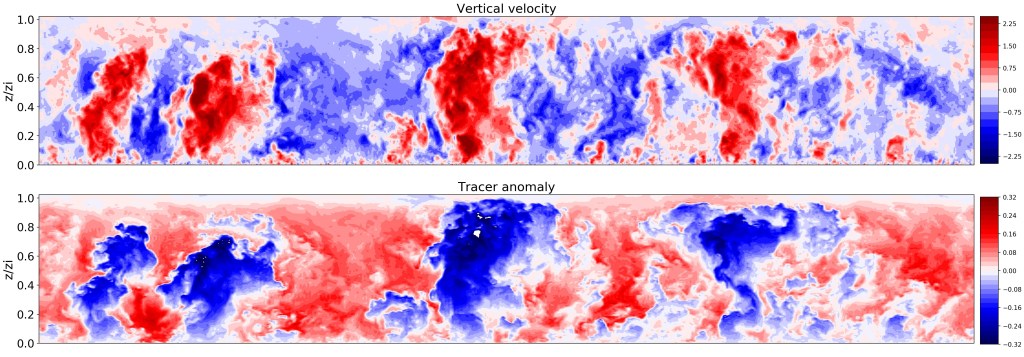
The plot shows the vertical profile of vertical velocity and a height dependent tracer anomaly in convective boundary layer. The data is generated using Large Eddy Simulation
The atmospheric boundary layer (ABL) is a thin layer of the atmosphere closest to the Earth’s surface, which is characterized by turbulent mixing of air caused by surface friction. ABL plays a vital role in regulating the exchange of heat, moisture, and gases between the atmosphere and the underlying surface, including the ocean. The exchange of gases, such as carbon dioxide and oxygen, is crucial for the health of the biosphere. The ABL is also important for cloud formation since it provides the necessary moisture and upward motion of air to form clouds. Understanding the dynamics of the ABL is therefore crucial for predicting weather patterns, ocean-atmosphere exchange, and climate change.
Climate and weather models have a coarse resolution, meaning they cannot resolve turbulent mixing at scales smaller than their resolution. As a result, they cannot accurately capture small-scale atmospheric processes that play a significant role in the exchange of heat, moisture, and gases between the atmosphere and the underlying surface. To account for these unresolved turbulent fluxes, climate models use parameterizations that approximate the fluxes based on large-scale variables such as wind speed and temperature. Accurate representation of the ABL is crucial for predicting surface-atmosphere exchange, as well as exchange between the boundary layer and free troposphere. However, the parameterizations used in climate models to represent the ABL often fail to accurately capture the complexity of turbulent mixing, which can lead to significant errors in predicting atmospheric processes. In addition to surface-atmosphere exchange, the representation of the ABL is also important for predicting cloud formation and characteristics, as the ABL plays a crucial role in the vertical transport of moisture and other atmospheric constituents. Improving the representation of the ABL in climate models remains a major challenge in climate science, and further research is necessary to better understand and parameterize these complex processes.
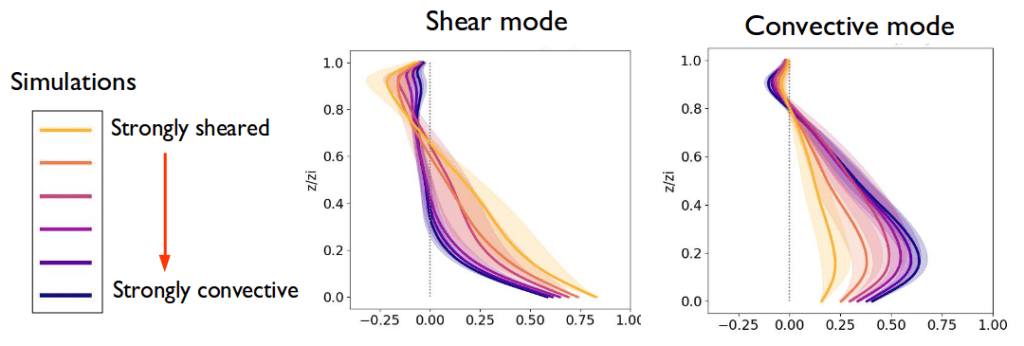
Plots show two main modes of variability decomposed using a novel neural network architecture which embeds a physical constraint. Link to the paper
I conduct research on the atmospheric boundary layer using innovative machine learning techniques that incorporate physical knowledge to improve our understanding of the physics of the convective boundary layer, specifically during sunny afternoon situations. One of my objectives is to develop a data-driven parameterization of the boundary layer vertical turbulent fluxes. To achieve this, I enforce a physical constraint in the architecture of a neural network. This allows me to decompose the total flux into two primary modes of variability, one associated with shear-flow interaction, and the other with surface heating and flow interaction. Wind shear and surface heating are the two main forces that control the dynamics of the ABL. Above is a plot that demonstrates this decomposition, which has significant implications for understanding the dynamics of the atmospheric boundary layer and improving the representation of its processes in climate and weather models.
Paper:
S. Shamekh and P. Gentine, (2023); Learning Atmospheric Boundary Layer Turbulence
 Sara Shamekh