Category Archives: Uncategorized

Growth vs Fixed Mindset


I learned about the concept of growth versus fixed mindsets originally through a podcast that featured an interview with Dr. Carol Dweck. It was a very interesting discussion. Dweck, who originally introduced this concept, shared insights and personal anecdotes from her research and teaching experiences that really brought the idea to life. It was intriguing, the way she talked about observing her students’ reactions to challenges and how those observations sparked the theories she’d later explore in depth.

Dweck discusses the growth and fixed mindset in her book titled “Mindset: The New Psychology of Success”. The book’s title initially gave me the wrong impression because of the word ‘success.’ I thought it was another typical self-help book, suggesting secrets to unlocking your best self or becoming the ultimate success story. However, the podcast painted a different picture. Hearing Dweck discuss her work made me realize that the title might be misleading, but the substance of her message was anything but shallow. She explored how adopting a growth mindset can profoundly impact not just academic or professional success, but also personal growth and resilience.

The concepts of growth and fixed mindsets, as articulated by psychologist Carol Dweck, offer a compelling framework for understanding how our beliefs about our own abilities influence our behavior and success. A growth mindset embodies the belief that our talents and abilities can be developed through dedication, perseverance, and hard work. This perspective champions the idea that challenges are opportunities for growth, encouraging individuals to embrace effort as a path to mastery and to view setbacks as informative and instrumental for learning.

Conversely, a fixed mindset is the belief that one’s abilities, intelligence, and talents are fixed traits, meaning that they cannot change in any meaningful way. People with a fixed mindset often avoid challenges, fearing that failure might expose a lack of ability. They are more likely to give up easily when faced with obstacles and may see effort as fruitless if talents are perceived as innate rather than developed. A fixed mindset can limit personal and professional growth because it leads individuals to avoid experiences where they might fail or make mistakes, thereby missing out on valuable learning opportunities.

The impact of growth and fixed mindsets goes far beyond just our personal achievements, touching on our motivation, resilience, and the way we connect with others. By practicing a growth mindset, we start to see life differently: challenges become chances to improve, and setbacks are just part of the learning curve. This shift in perspective doesn’t just make us more open to trying new things—it makes us stronger when life inevitably gets tough. With this mindset hopefully we see ourselves as a work in progress is not just okay, which is exactly where we’re supposed to be. It’s a powerful way to navigate life, minimizing stress and making our journey a bit smoother.

Throughout my journey in as a student and in the wider world, I’ve observed the profound impact of mindset. It became evident early on that a fixed mindset, where abilities are seen as inherent and unchangeable, was prevalent among some educators, promoting a “You’ve either got it or you don’t” mentality. This perspective can significantly limit growth and discourage learners. However, my experiences with mentors who embraced a growth mindset introduced a pivotal shift in perspective. They emphasized the importance of the learning process over immediate skill possession, illustrating that growth and improvement are always within reach.


Cloud Responses to Ocean-Atmosphere Coupling

Plot shows the horizontal profile of (first row) column relative humidity and (second row) ocean surface temperature anomaly. Data are produced using cloud resolving model, SAM.

The interaction between the ocean and atmosphere is a complex and dynamic process that has a significant impact on cloud formation and behavior, as well as the atmospheric boundary layer. The exchange of heat, moisture, and momentum between these two systems plays a critical role in shaping weather patterns, ocean currents, and climate. For example, the temperature of the ocean can affect the stability of the air above it, which in turn can influence the development of clouds and precipitation. In addition, the ocean serves as a major source of water vapor and energy for the atmosphere, which can have a significant impact on the structure, moisture content and behavior of clouds. Understanding these interactions between the ocean and atmosphere is essential for accurately predicting weather and climate, as well as for managing and mitigating the impacts of climate change.

Cloud and precipitation processes can also impact the ocean, creating ocean surface temperature anomalies that can persist for several hours and have a significant impact on the evolution of atmospheric boundary layer and clouds locally. For example, rain and evaporative cooling can cause a decrease in sea surface temperature and creating local negative anomalies. These anomalies can impact the stability of the air above the ocean and influence the formation and behavior of clouds. In turn, changes in the cloud and precipitation patterns can lead to further oceanic anomalies, creating a feedback loop between the two systems. Understanding these feedbacks between the ocean and atmosphere is critical for predicting and mitigating the impacts of climate change.

During my PhD, I focused on studying the interaction between the ocean surface and atmosphere, specifically how sea surface temperature (SST) anomalies affect the organization of convection using cloud-resolving simulations. One of my studies showed that a warm SST anomaly, also known as a hot spot, can significantly accelerate the organization of convection by generating a local circulation that creates convergence of moisture towards the hot spot, making it a favorable environment for future convection and precipitation. The strength of the large-scale circulation is determined by the hot spot’s fractional area and its temperature anomaly.

In another work I investigated the feedbacks between interactive SST and the self-aggregation of deep convective clouds. I found that the interactive SST decelerates the aggregation and that the deceleration is larger with a shallower ocean slab. However, the driest columns eventually have a negative SST anomaly, which strengthens the diverging shallow circulation and favors aggregation. This diverging circulation out of dry regions is well correlated with the aggregation speed and can be linked to a positive surface pressure anomaly, which itself is the consequence of SST anomalies and boundary layer radiative cooling. These findings highlight the complex and interconnected nature of ocean-atmosphere interactions and how they impact cloud formation and organization. Figure above shows the column relative humidity and SST anomaly in an coupled ocean-atmosphere set-up.

One question that has not received enough attention is whether the small-scale ocean anomalies that form due to rain evaporation and cold pool propagation need to be parameterized. Although these small anomalies may not have a significant impact on the ocean, they play a crucial role on the formation of shallow circulation, evolution and emergence of sub-grid-scale cloud structure, as well as the atmospheric boundary layer process. This would be an interesting avenue to explore!

Papers:
S. Shamekh, C. Muller, J.-P. Duvel, F. D’Andrea; JAS(2020); “How Do Ocean Warm Anomalies Favor the Aggregation of Deep Convective Clouds?

S. Shamekh, C. Muller, J.-P. Duvel, F. D’Andrea; JAMES(2020); “Self-Aggregation of Convective Clouds With Interactive Sea Surface Temperature”

C. Muller et al, ARFM(2022); “Spontaneous aggregation of convective storms

The Emergent Impacts of Mesoscale Patterns

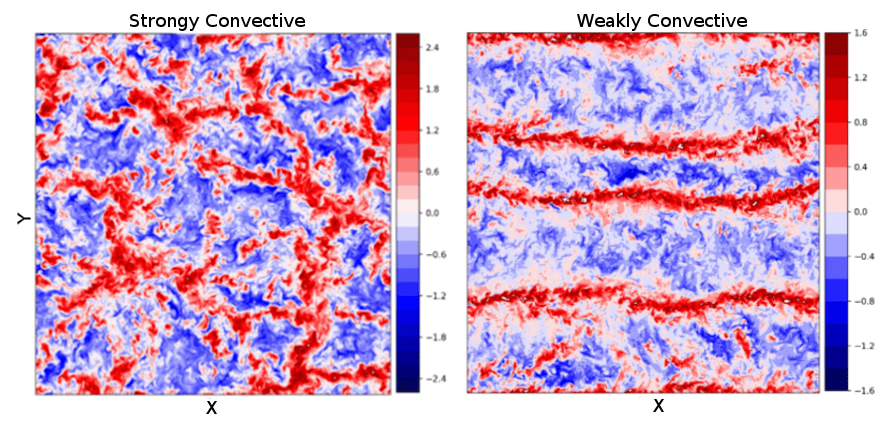
Numerous atmospheric processes exhibit diverse forms and structures, which can appear either random or organized. A key inquiry pertains to the influence of a physical process’s structure on its emergent impact or behavior. This question not only piques our scientific curiosity but also has significant implications for modeling physical phenomena. For instance, does organized convection leave a different footprint than random convection? The structural differences between roll and cell patterns in the convective boundary layer, as depicted in the image below, and their impact on the vertical mixing and flux of various quantities, such as heat, pollutants, and dust, is another example. Addressing these queries can provide valuable insights into the intricate workings of the atmosphere and facilitate the development of more accurate physical models.


Plot shows a horizontal cross section of vertical velocity in a (left) strongly convective, weakly sheared and (right) weakly convective, strongly sheared boundary layer, generated using large eddy simulation.

Weather and climate models that use a discretized representation of continuous equations approximate the impact of small-scale physics (which is smaller than the model’s grid) as a function of large-scale quantities (which are equal to or larger than the model’s grid). In doing so, the models generally ignore the structure of the unresolved physical processes. The question of whether or not we need to incorporate the missing piece of information regarding the structure of unresolved physical processes, as well as how to do so effectively, has not received an adequate response.

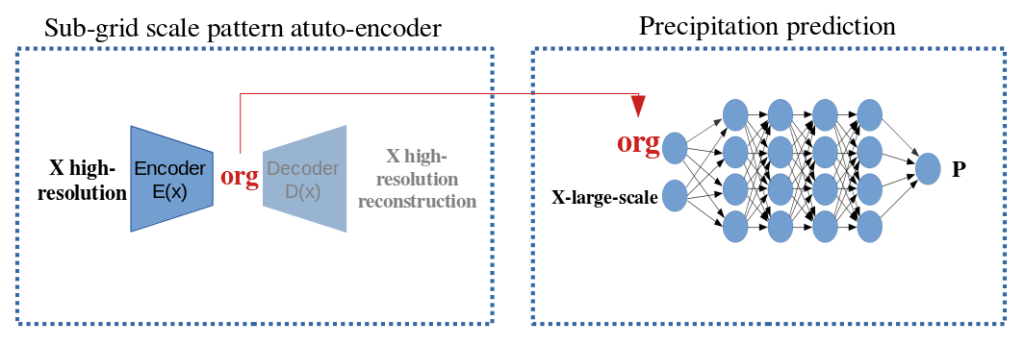
Machine learning algorithms are powerful tools that can help investigate both “whether” and “how” to effectively model sub-grid-scale structures. In our recent paper, we develop a novel neural network architecture to examine cloud organization and its impact on precipitation. Our network uses an auto-encoder to implicitly learn sub-grid-scale information relevant for predicting precipitation, which it then passes on to a feed-forward neural network. Our findings demonstrate that the latent representation of the auto-encoder effectively encodes sub-grid-scale information, leading to significantly improved precipitation predictions. Furthermore, building on this work, we investigate whether the sub-grid-scale structure also contains information that is relevant for predicting radiation.

Plot shows the architecture of the neural network: (left), an auto-encoder is applied to the high-resolution moisture field. (Right), the feed-forward network receives both large-scale variables and the latent representation of the auto-encoder to predict precipitation.

Our innovative neural network architecture, which employs two distinct machine learning tools to handle two scales – resolved and unresolved – is a groundbreaking approach with broad applicability. This architecture has the potential to revolutionize how we model and quantify complex two-field systems that require more than just mean or variance-based approaches. From studying the heat conductivity of ice sheets to representing land properties, the possibilities are endless..

Paper:
S.Shamekh et al ,PNAS (2023); Implicit learning of convective organization explains precipitation stochasticity

Atmospheric Boundary Layer Modeling

Relevance: vertical turbulent fluxes, atmosphere-ocean interaction, atmosphere – land interaction, boundary layer-free troposphere exchange, low cloud formation, etc

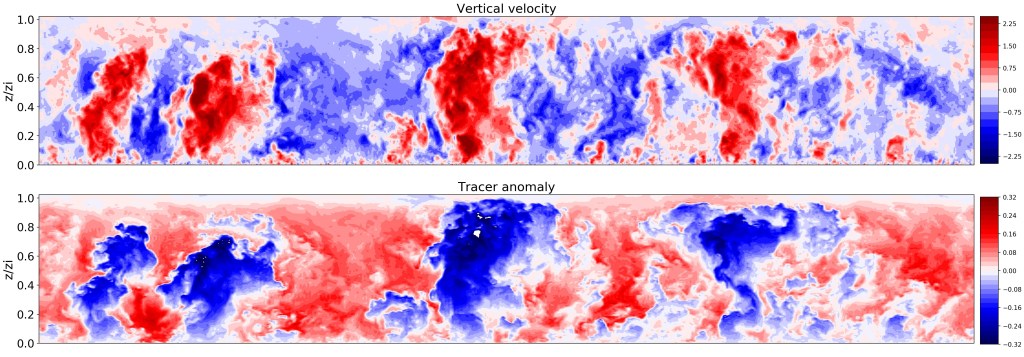
The plot shows the vertical profile of vertical velocity and a height dependent tracer anomaly in convective boundary layer. The data is generated using Large Eddy Simulation

The atmospheric boundary layer (ABL) is a thin layer of the atmosphere closest to the Earth’s surface, which is characterized by turbulent mixing of air caused by surface friction. ABL plays a vital role in regulating the exchange of heat, moisture, and gases between the atmosphere and the underlying surface, including the ocean. The exchange of gases, such as carbon dioxide and oxygen, is crucial for the health of the biosphere. The ABL is also important for cloud formation since it provides the necessary moisture and upward motion of air to form clouds. Understanding the dynamics of the ABL is therefore crucial for predicting weather patterns, ocean-atmosphere exchange, and climate change.

Climate and weather models have a coarse resolution, meaning they cannot resolve turbulent mixing at scales smaller than their resolution. As a result, they cannot accurately capture small-scale atmospheric processes that play a significant role in the exchange of heat, moisture, and gases between the atmosphere and the underlying surface. To account for these unresolved turbulent fluxes, climate models use parameterizations that approximate the fluxes based on large-scale variables such as wind speed and temperature. Accurate representation of the ABL is crucial for predicting surface-atmosphere exchange, as well as exchange between the boundary layer and free troposphere. However, the parameterizations used in climate models to represent the ABL often fail to accurately capture the complexity of turbulent mixing, which can lead to significant errors in predicting atmospheric processes. In addition to surface-atmosphere exchange, the representation of the ABL is also important for predicting cloud formation and characteristics, as the ABL plays a crucial role in the vertical transport of moisture and other atmospheric constituents. Improving the representation of the ABL in climate models remains a major challenge in climate science, and further research is necessary to better understand and parameterize these complex processes.

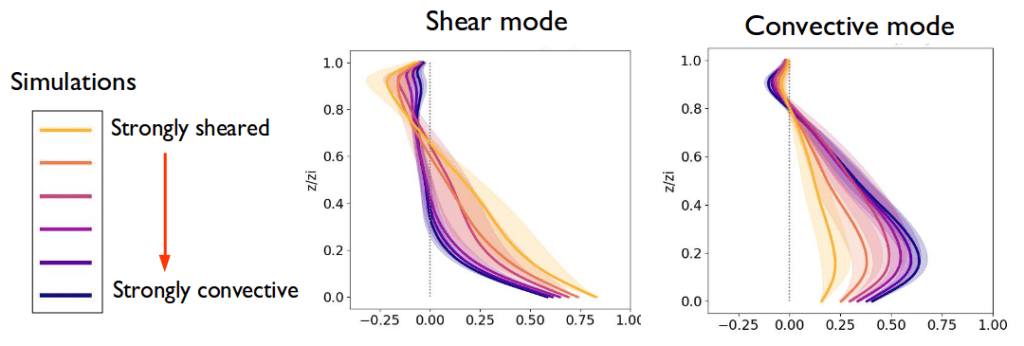
Plots show two main modes of variability decomposed using a novel neural network architecture which embeds a physical constraint. Link to the paper

I conduct research on the atmospheric boundary layer using innovative machine learning techniques that incorporate physical knowledge to improve our understanding of the physics of the convective boundary layer, specifically during sunny afternoon situations. One of my objectives is to develop a data-driven parameterization of the boundary layer vertical turbulent fluxes. To achieve this, I enforce a physical constraint in the architecture of a neural network. This allows me to decompose the total flux into two primary modes of variability, one associated with shear-flow interaction, and the other with surface heating and flow interaction. Wind shear and surface heating are the two main forces that control the dynamics of the ABL. Above is a plot that demonstrates this decomposition, which has significant implications for understanding the dynamics of the atmospheric boundary layer and improving the representation of its processes in climate and weather models.

Paper:

S. Shamekh and P. Gentine, (2023); Learning Atmospheric Boundary Layer Turbulence